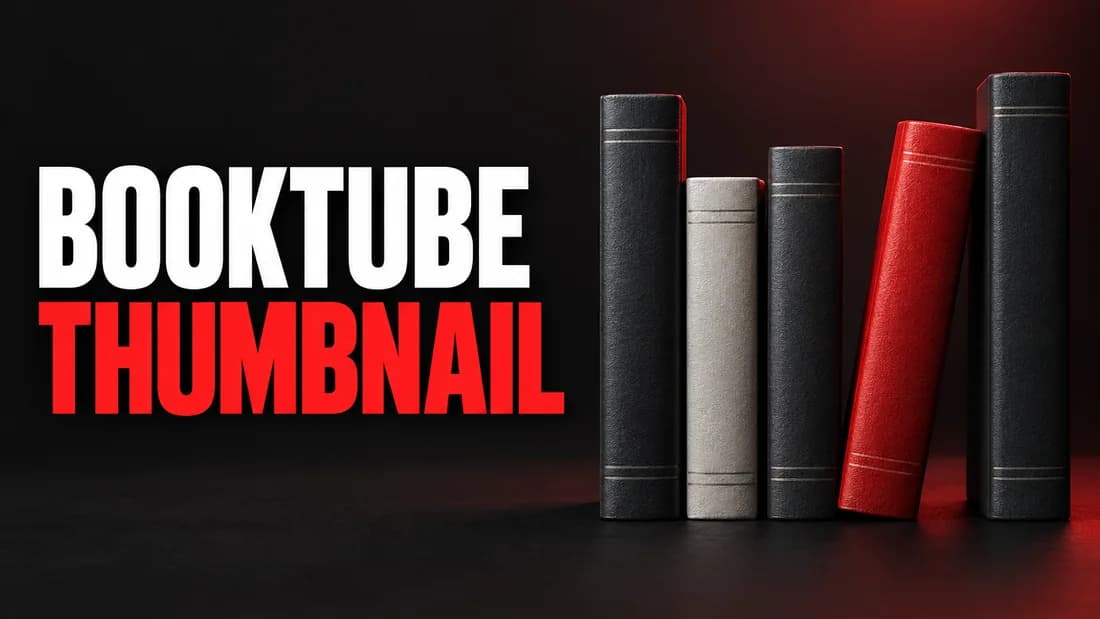
BookTube thumbnail ideas come down to two decisions: what the words promise (a verdict, a count, a month) and whether the publisher's cover is on the image at all. The second is the question under the whole niche, and nobody official answers it directly. As of September 2026, YouTube's Fair use on YouTube page lists four factors, names commentary and criticism among the common examples, and does not mention thumbnails once. So this post gives you the factors, not a verdict, and then a route that sidesteps the question: your own photo of the physical book, small, with your reaction or a stack of spines doing the rest.
The format repeats across reviews, hauls, TBRs, wrap-ups and rankings, with or without your face, and one run in WThumb gives you the 16:9 and the 9:16 for the reading-vlog Short.
Can the book cover be on the thumbnail?
This section applies YouTube's four fair use factors to two versions of the same thumbnail: the publisher's cover file filling the frame, and the physical book in your hand at a fifth of the width. As of September 2026, YouTube's Fair use on YouTube page lists the purpose and character of the use, the nature of the copyrighted work, the amount and substantiality of the portion used, and the effect of the use upon the potential market. It says borrowing small bits of material is more likely to be considered fair use than borrowing large portions, and that nonprofit education uses are more likely to qualify than commercial uses. The same page also says there aren't any magic words to automatically apply fair use, and that different countries and regions may have different rules.
Run the full-frame cover through the factors. It is the whole work, not a small bit. A monetized review is commercial. The cover is a creative work, and a full-size copy competes with the publisher's own use of it. Now run the book-in-hand version: a fraction of the frame, unmistakably criticism, and nothing the publisher could sell. Neither is a ruling; there are no magic words, and rules differ by country. What the comparison shows is direction. Smaller, in your hand, beside your opinion, is safer than larger and alone.
Two myths that BookTube leans on
Owning the book is not owning the cover. As of September 2026, YouTube's Common copyright myths page says that just because you purchased content doesn't mean you own the rights to upload or distribute it on YouTube, and that giving credit to the copyright owner doesn't automatically give you the rights to use their copyrighted content. A line in the description naming the publisher changes nothing, and that page adds that disclaimers such as I do not own or no infringement intended don't mean you have the rights. The same four factors are run against a downloaded image in using a picture from Google Images as a YouTube thumbnail.
So the rest of this post photographs your own copy, keeps it small, and lets the words and your reaction fill the frame.
Five jobs, and the words for each
This section is the format: five kinds of BookTube video, each with one job for the words and one for the picture. The book is always your own photo, attached as @1 and kept small. The words carry the promise, which is also how the YouTube thumbnail ideas guide sorts formats for every niche.
- The review: the verdict. 5 STARS or DNF does more work than REVIEW. A viewer who sees DNF beside a hyped title knows the video before the title loads. The book in hand, your face doing the verdict.
- The haul: the count. 14 BOOKS, and a stack that is visibly fourteen. The picture proves the words. A neat pile of three under 14 BOOKS reads as a lie before anyone counts.
- The TBR: the month. OCTOBER TBR, with the pile spines out and unread. The month is the promise; the stack is the menu. Keep the same corner of the same shelf every month and the series becomes recognizable at a glance.
- The wrap-up: the number read. READ 9 with the finished pile, or 9 BOOKS 1 DNF if the DNF is the story. A wrap-up is the one job where the count can be smaller than the TBR promised, and the honest gap is part of the appeal.
- The ranking: the top pick face up. RANKED, with the winner held toward the camera and the rest fanned behind it. The thumbnail asks which one, so show the answer half-hidden, not the whole list.
Notice what is missing: no cover fills the frame in any of the five. The words replace the cover as the reason to click, and a viewer who wants to know which book is on top opens the video. The same five work for an author's channel: the verdict becomes the milestone (DRAFT DONE, COVER REVEAL, PUB DAY) and the book in hand is your own title, so the cover question is one you can put to your own publisher.
A brief to paste
- Words. DNF on one line.
- Instructions. The book in @1 is the subject, held small at the edge of the frame, my face large and unimpressed, warm lamp light, a shelf behind me.
With your face or without
This section decides the second choice: your reaction large and the book small, or no person at all. Both work on BookTube because the niche is built on rooms, chairs and shelves that viewers come back to.
Reaction large, book small
For a review or a ranking, your face is the verdict before the words are read. Hold the book at chest height, cover toward the camera but a fifth of the frame at most, and react to it: the wince for DNF, the wide eyes for 5 STARS. The book is evidence; you are the opinion.
Faceless: spines, hands and the chair
For a TBR, a haul or a reading vlog, the room can carry the thumbnail. A stack of spines on the desk with the month above it. Two hands holding a book open over a blanket, no face in the shot. The empty reading chair with the lamp on and the pile beside it. Each is a scene viewers recognize as yours after three videos, and none needs you camera-ready on a Sunday night. The wider set of options is in faceless channel thumbnails. In WThumb, skipping the personal photo gives you exactly this: the person in the reference is removed and the space is filled in the same style, so a reference with a face still produces a faceless design, and nobody else's face is ever put in.
A brief to paste
- Words. OCTOBER TBR on two lines.
- Instructions. No person. The stack in @1 spines out on a wooden desk, a lamp glow from the left, the month large above it.
Numbers and counts without clickbait
This section is one rule with a policy behind it: the count on the image is the count in the video. As of September 2026, YouTube's Thumbnails policy page says a thumbnail that misleads viewers to think they're about to view something that's not in the video is not allowed, and that images include banners, avatars, posts, and any other YouTube feature that has images. A 30 BOOKS haul that unboxes twelve is inside that sentence.
The other way numbers go wrong is softer than a policy strike. 14 BOOKS on a stack of nine breaks no rule if fourteen are in the video, but a viewer who counts the stack and gets nine feels tricked anyway. Put the real stack in the photo, and the number and the picture agree. The wrap-up tempts the other way: READ 12 when three were abandoned halfway. Say 9 READ 3 DNF, or say 9. The finer line between a bold number and a misleading one is drawn in when numbers on a thumbnail read as clickbait.
A count also has to survive being small. Two digits and one word, nothing more: 14 BOOKS, READ 9, TOP 5. The moment the words become 14 BOOKS I BOUGHT THIS MONTH they are a title, and the title already exists.
A look that holds for a hundred videos
This section is the repeat: one chair, one light, one place for the words, so a subscriber spots your thumbnail in a feed of forty. As of September 2026, YouTube's Thumbnail & title tips page says content targeting your subscribers might highlight familiar features, and BookTube's familiar features are the room: the shelf behind you, the blanket, the mug, the lamp. The same page also says to try not to make the design too complex, and to limit ALL CAPS and emoji, using them carefully to emphasize emotion. Two words in capitals over a stack of spines is not complex. Five stickers, three arrows and a cover collage is.
Pick a BookTube thumbnail you admire and use it as the reference for the look, not for the layout. What carries over is the energy and the role each element plays: the book as evidence, the face as verdict, the room as the brand. What does not carry over is their composition; the design is new each time, and what you can borrow from another thumbnail style draws the line between a style and a copy. Keep your own constants fixed: the same corner of the same room, the words always in the upper third, the book always in the same hand.
The tips page has one more line for a series. It says to save episode numbers and branding for the end, aimed at titles, and it holds for thumbnails too: WRAP-UP #47 spends half the frame on a number nobody searches for. Put the month or the verdict first and let the title carry the episode number. When a number does earn space on the image is worked through in episode numbers on YouTube thumbnails.
How to do this in WThumb
This section is the run, from reference to finished 16:9 and 9:16.
- Paste the reference. Paste the link of a BookTube thumbnail you like (WThumb fetches only that video's public thumbnail) or upload a PNG, JPEG or WebP. It is a brief, not a template: the idea carries over, the design is new.
- Attach your photo of the book as @1. Photograph your copy held up, stacked or spines out, attach it as an extra image and point at it as @1.
- Type the words and one instruction line. Up to three lines: DNF, 14 BOOKS or OCTOBER TBR. Then one plain line: the book in @1 is the subject, small, my reaction large.
- Add your photo, or leave it out. With a personal photo, you are placed in the design. Without one, the thumbnail is faceless and the person in the reference is removed.
- Tick 16:9, 9:16 or both. Both in one submission gives the video thumbnail and the Short from one brief. Ask for one or two designs and wait about thirty seconds.
Photograph the book, do not upload the cover file
The attached image is a brief too, not a template. Hand WThumb the publisher's cover file and you have described a book, not ordered a copy of the file. Hand it a photo of your own copy and the design starts from something already yours, the safer route from the first section. Your words pass a moderation check before anything is generated, and a refused brief costs nothing.
No label needed, then revise
As of September 2026, YouTube's Disclosing use of GenAI content page lists using generative AI tools to create or improve a thumbnail under production assistance, which needs no label. If the book came out too large, the pencil on the thumbnail takes one sentence (make the book smaller) and makes one new version; each revision costs one credit (1 credit = 1 thumbnail). Also, new accounts get two free credits, no card needed.
The cover is theirs. The book in your hand is yours.