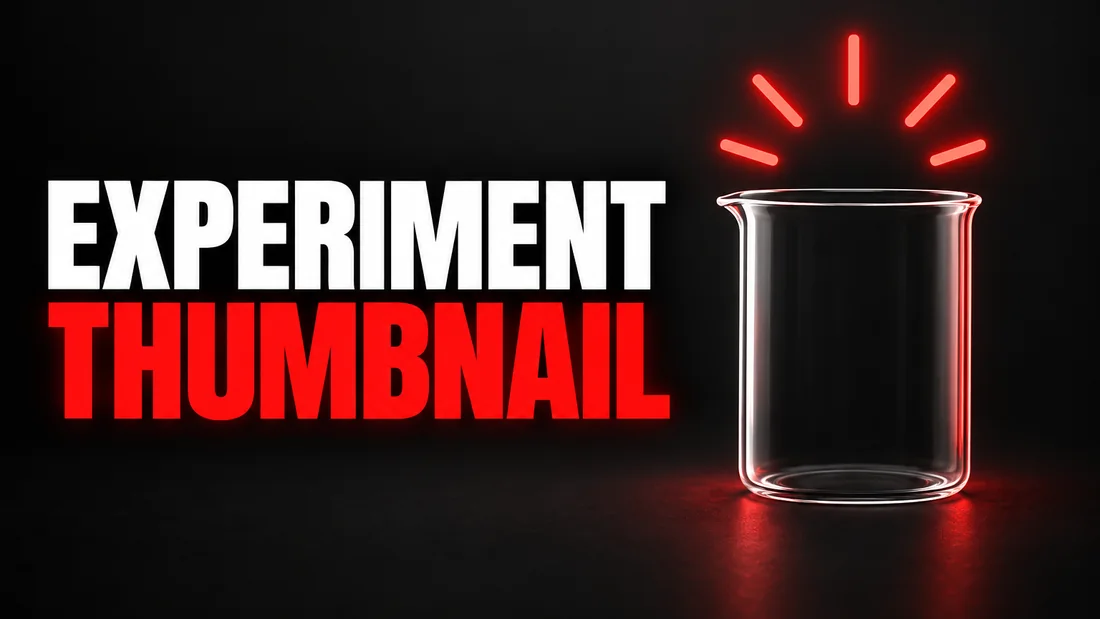
A science experiment thumbnail has one job: show the reaction at its peak, and show it as it actually happened. The foam frozen at the top of its climb, the dry ice cloud rolling over the rim, the spark at the battery terminal; that moment is the promise, and the video keeps it. As of September 2026, YouTube's Thumbnails policy page says not to post a thumbnail that misleads viewers to think they're about to view something that's not in the video, and a reaction drawn larger than the one you filmed is exactly that.
This post covers what a science experiment thumbnail can show, where YouTube's harmful-or-dangerous line bites, what changes for STEM for kids, and how to brief the real reaction in WThumb.
The reaction moment: the froth, the flame or the cloud at its peak
This section is about the single frame that carries the whole thumbnail: the reaction at its peak. Elephant toothpaste has a moment when the foam column is tallest and still rising; dry ice in warm water has one when the cloud spills over the rim and has not yet thinned; a short across a battery has one spark. The thumbnail is that frame.
Getting the frame is a camera job. Put the camera on a tripod, set it to burst, and start shooting before you pour; one frame in the burst will be sharp at the peak. Shoot against a dark, plain wall so the color carries, and fill the frame: a beaker at arm's length on a cluttered bench reads as a bench. How to take a photo for a YouTube thumbnail covers the shot list.
Dark ground is contrast, not style. Orange foam on a black wall reads at phone size; orange foam on a beige counter does not. YouTube thumbnail colors covers dark against light. As of September 2026, YouTube's Thumbnail & title tips page says dynamic use of color and composition can help catch the eye, but too much can overwhelm it. One reaction, one color, one dark ground does not overwhelm.
A brief to paste
- Words. IT ERUPTED on one line, or no words at all: the foam is the words.
- Instructions. The foam column at its highest point, orange against a black wall, the beaker large and sharp, nothing else on the bench.
The number: one true figure does more than SCIENCE!
This section is about the words, and the argument is short: a number you measured does more work than SCIENCE! ever will. 1000°C, if that is what the probe read, is a fact the viewer can picture. 12 VOLTS says how the spark was made. 50 LITERS says how much foam came out. Each is a promise the video can check, and each is shorter than a slogan.
The rule has two halves. One number, because two numbers on a thumbnail are a spreadsheet, and the true one, because the number is the promise. If the probe read 800°C, the thumbnail says 800°C, not 1000°C. A rounded number is fine. An inflated one is the misleading thumbnail the thumbnails policy names, and the viewers who came for the bigger number leave early.
A number with a unit is a handful of characters, so it can be huge, in a heavy plain face. Put it beside the reaction, not over it: the number labels the foam, it does not hide it. Drop the exclamation mark; 12 VOLTS is already loud.
A brief to paste
- Words. 12 VOLTS on one line.
- Instructions. The spark at the battery terminal, the wire and clip large, dark ground, the number beside the spark in heavy plain type, nothing over the spark.
The versus and the question: COKE VS MENTOS, WILL IT FLOAT?
This section covers the two other word formats that fit experiments: the versus and the question. COKE VS MENTOS names both halves of a comparison, and the viewer already knows what happens; the pull is the scale. WILL IT FLOAT? is a question the video must answer. Both are general formats, and the YouTube thumbnail ideas for every format sort them with the other eight by what they promise.
The versus works when the video is a comparison. DIET VS REGULAR on the same fountain. COPPER VS ZINC on a lemon battery. The thumbnail shows both, side by side, mid-reaction, and the words label the halves. It fails when one side is not in the video: COKE VS PEPSI on a video that only opens the Coke is the misleading line again.
The question works only when the video answers it. WILL IT FLOAT? on a bowling ball over a tank is fine; the ball floats or sinks, on camera. DOES IT EXPLODE? on a video where nothing explodes is bait. Keep the answer off the thumbnail: show the ball entering the water, not the ball floating. Neither format needs an exclamation mark.
A brief to paste
- Words. WILL IT FLOAT? on one line.
- Instructions. A bowling ball an inch above the surface of a clear tank, water still, dark ground, the question above the tank, no splash yet.
The face in goggles: the shocked face, and the precautions in the frame
This section is about you in the frame, and the one face YouTube's own guidance names. As of September 2026, YouTube's Thumbnail & title tips page says content targeting casual viewers might focus on actions and emotions that are more universally relatable, like a shocked face. An experiment channel is built for casual viewers. So the shocked face is the right face, shocked at the reaction, not the camera: eyes on the foam, mouth open.
The goggles are the point. A face in safety goggles, gloves and a lab coat says two things at once: this is a real experiment, and this person took it seriously. The dangerous-content policy, covered next, wants context about precautions, and goggles are the most visible precaution there is. They set the register before the click. A bare face beside a fireball sets a different one. Health channels set the same register with a calm clinician rather than a scare, as the medical thumbnail ideas show.
Shoot the face in the same burst as the reaction if you can, goggles on, the foam in the frame. If the reaction needs both hands, shoot the face separately against the same wall. Faceless is a real option: the apparatus, the flame or the foam can fill the frame with no person at all.
A brief to paste
- Words. NOT WHAT I EXPECTED on two lines.
- Instructions. Me in goggles and gloves, shocked, looking at the foam not the camera, the foam column beside me at its peak, black wall behind.
Where the policy bites: the disclaimer, the ads and the strike that is not one
This section covers three YouTube pages in order. As of September 2026, YouTube's Harmful or dangerous content policy says it applies to videos, video descriptions, comments, live streams, and any other YouTube product or feature; it does not name thumbnails. The same page says YouTube doesn't allow content that encourages dangerous or illegal activities that risk serious physical harm or death, and its examples include activities with a serious risk of severe burns, freezing, frostbite, or electrocution, and consuming chemicals that may cause illness or poisoning. Most kitchen chemistry is nowhere near this list. A thermite pour is on it.
Why the disclaimer is not enough
That page adds the line every experiment channel should read: saying, Don't try this at home is not sufficient context. What counts is educational, documentary, scientific, or artistic context, with examples like information about the risks of the act and the precautions or training required to do it safely. That context lives in the video: the risks named before the pour, the goggles going on, the extinguisher in shot. The thumbnail cannot supply it, but it can match it.
The ad guidelines do name the thumbnail
As of September 2026, YouTube's Advertiser-friendly content guidelines say the policies apply to all portions of your content, thumbnail included. Under harmful or dangerous acts, the same page rates slightly dangerous stunts performed in a professional and controlled environment where no one is seriously injured as suitable for ads, acts done in a non-professional, non-controlled environment as limited ad earnings, and content that mainly shows experiments or stunts that have health risks as no ad earnings. Under shocking content, that page also names highly shocking content where the whole purpose of the video is to shock viewers. A thumbnail that sells the burn is read that way.
The thumbnails policy and the no-strike outcome
As of September 2026, YouTube's Thumbnails policy page lists violent imagery that intends to shock or disgust and graphic or disturbing imagery with blood or gore among what not to post. That page adds that when a thumbnail may not be appropriate for all audiences but does not violate the Community Guidelines, YouTube may age-restrict the video, or remove the thumbnail, but does not issue a strike. So the usual cost is a pulled image or a restricted video; the full list is in YouTube thumbnail rules.
STEM for kids: calm colors, a fizz, and no fire in the frame
This section covers experiments made for children, where the thumbnail changes register. If the video is made for kids, made for kids thumbnail rules covers what that setting changes and what a family thumbnail can show; this section is about the picture.
Three moves. Calm colors: bright, flat, friendly color, a blue ground and a yellow reaction, not the black wall of the adult version. A gentler reaction: still the subject, but a fizz, a color change or a floating egg, not a fireball. No fire in the frame: even where a small supervised flame is safe in the video, a flame on a thumbnail for children reads as an invitation. An adult hand doing the pour makes the scale and the supervision visible.
The words shrink too. 12 VOLTS becomes a question a child would ask: WHY DOES IT FIZZ? BAKING SODA VS VINEGAR shows both halves with nothing dangerous in either. Leave the shocked face out; a delighted one does the same job here.
A brief to paste
- Words. WHY DOES IT FIZZ? on two lines.
- Instructions. A clear jar mid-fizz with blue and yellow foam rising, an adult hand holding a spoon above it, flat bright blue ground, no flames, no sharp glassware.
How to do this in WThumb
This section is the flow, with a science channel's thumbnail as the reference.
- Paste the reference. Paste the YouTube link of a science thumbnail you admire (WThumb fetches only that video's public thumbnail) or upload a PNG, JPEG or WebP. The reference is a brief, not a template: the idea carries over, the design is new.
- Type the words. Up to three lines: the number, the versus or the question. 12 VOLTS on one line.
- Write one line of instructions. The foam at its peak, dark background, goggles on me. Attach the real apparatus as @1 and name it: @1 is the beaker, keep it as it is.
- Add your photo, or skip it. With a photo of you in goggles mid-reaction, you are placed in the design. Skip it and the thumbnail is faceless: the person in the reference is removed and the space is filled in the same style, so the apparatus carries the frame. Nobody else's face is ever put in.
- Pick 16:9, 9:16 or both, one or two designs. One brief can make both.
- Wait about thirty seconds. The result is a Full HD+ JPEG. The pencil on it takes one sentence and makes one new version; each revision costs one credit (1 credit = 1 thumbnail).
Brief the real size of the reaction
The honest limit is that WThumb renders what you ask for: a foam column briefed at twice the height you filmed comes back that way, the misleading thumbnail from the intro. Brief the real one: attach the real photo as @1, or as the personal photo if you are in it, and write the foam as in @1, no bigger. As of September 2026, YouTube's Disclosing use of GenAI content page lists production assistance, like using generative AI tools to create or improve a thumbnail, among what creators don't have to disclose, and generating a realistic scene that didn't actually occur among what they do. Brief the real reaction and your thumbnail stays on the first list. And new accounts get two free credits, no card needed.
The reaction you filmed is the thumbnail. A bigger one is a promise you cannot keep.