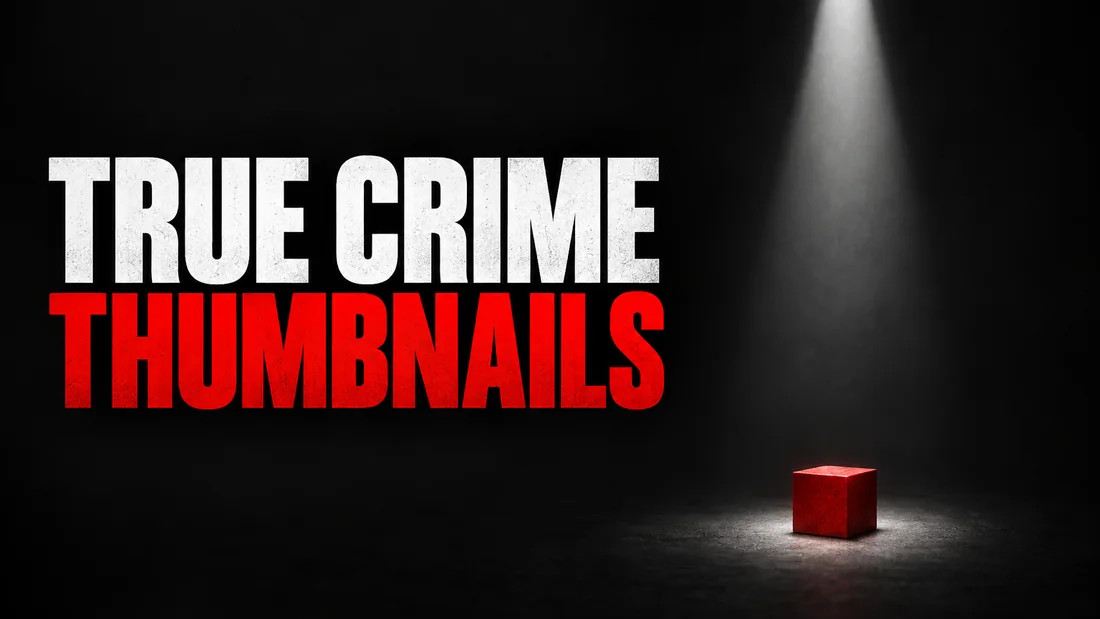
A true crime thumbnail has to look serious in the dark without showing anything YouTube treats as graphic. The answer is faceless: one lit object, a house or road at night, a document, a silhouette or a map, and a place or a year in three words or fewer. Many cases have no usable archival image, and the obvious shortcuts (a crime scene photo, a victim's face, a smear of red) bring review, an age restriction or a removal. As of September 2026, YouTube's Thumbnails policy says "Graphic or disturbing imagery with blood or gore" is not allowed in a thumbnail.
This post gives you those five formats, a rule for the words, the policy lines that matter, quoted and dated, and a brief to paste into WThumb. We do not say which format gets watched more, because we do not know your audience.
What a true crime thumbnail has to do without a face
This section covers what a faceless thumbnail communicates, and what does the communicating.
A face sells an emotion. A true crime thumbnail sells an event and a place. The viewer is asking what happened, where, and whether the telling is serious, not how you feel about it. So the niche is faceless by default. Here the composition matters more than the face, and three things do the work an expression does elsewhere.
- Light. One source, low and from the side, or spilling under a door. A dark frame with one lit area reads as night and as attention; flat, even light reads as stock.
- One object. A cassette recorder, a case file, two headlights on a wet road. One thing for the eye to land on; two split it, five is a collage.
- A date or a place. 1994. ROUTE 9. THE HARLOW FARM. A concrete fact makes the frame feel like a record rather than a mood board.
Serious and dark are not graphic. A house at night with one lit window is dark. A doorway with red on the frame is graphic. As of September 2026, YouTube's Thumbnail and title tips page says "Try not to make the design too complex", which here means one lit thing, one line of words, nothing else. The faceless thumbnail maker in WThumb builds that kind of frame around a lit object or a place, from a reference and your words.
Five faceless true crime formats
This section gives five formats that work with nobody in the frame and says which case each suits. The general advice on faceless channel thumbnails applies here too; these are the true crime cuts. The wider set, sorted by promise, is in the YouTube thumbnail ideas for any channel.
The lone object
An evidence bag, a cassette recorder, a single shoe on asphalt. One object on a dark ground, lit from one side. It suits a case that turns on one piece of evidence or one recording. Words: what the object is, or the year it was found.
The house or road at night
A suburban house with one lit window, a rural road under one streetlight, a motel sign with a letter out. It suits disappearances and cold cases, where the place is the last certain fact. Words: the place name, or LAST SEEN HERE.
The document or newspaper card
A folded case file, a typed report with a stamp, a front page with the headline out of focus. It suits historical cases and anything built on court records: the document says archive without needing one. Words: the year and the case name, set as if typed.
The silhouette
A figure in a doorway, backlit, no features. It suits cases with an unknown suspect, because the silhouette is the unknown. Keep it a shape, not a person anyone could recognize.
The map with one pin
A dark map, one red pin. It suits multi-location cases and anything where the geography is the story. Words: the town and a distance, or the town and a year.
A brief to paste
- Words. MISSING SINCE 1994, one line, nothing else.
- Instructions. A rural road at night under one streetlight, wet asphalt, cold light, conceptual and cinematic, no people, no blood, no vehicles, words small and plain in the lower third.
The words: three or fewer and never a verdict
This section covers the words: how many, what kind, and the one thing they must never do.
Three words or fewer, usually one fact: a place, a year, a first name. THE HARLOW FARM. MISSING SINCE 1994. ROUTE 9, 1987. The words are the caption on a record, not a headline, and never an adjective that promises horror; that is the shock intent the policy names. Long words fight the dark image.
Never a verdict the episode does not settle. MISSING SINCE 1994 is a fact you can stand behind for the whole video. KILLER FOUND is a claim, and if the case is still open at the end, the thumbnail lied. As of September 2026, YouTube's Thumbnails policy says "A thumbnail that misleads viewers to think they're about to view something that's not in the video" is not allowed, and counts "Whether written text is intended to be vulgar or shock or disgust viewers" among the factors it weighs.
Legibility matters more on a dark ground. As of September 2026, YouTube's Thumbnail and title tips page says "If you add text, make sure to use a font that's easy to read." White or pale gray on near-black, a plain face, no glow, no drop shadow; in WThumb, put plain white type, no effects, in the instruction line.
What YouTube's policies say about this niche
This section quotes the policy pages that decide a true crime thumbnail's fate, dated to the month we read them.
Violent or graphic content
As of September 2026, YouTube's Violent or graphic content policies page says "this policy also applies to videos, video descriptions, thumbnails, comments, live streams". Its not-allowed list names "Footage, audio, or imagery involving road accidents, terrorist attack aftermath, street fights, physical attacks, immolation, torture, corpses, robberies, or other such scenarios with the intent to shock or disgust viewers." For educational content it says "this context must appear in the images or audio of the video itself", and a thumbnail carries none. It also says "We may apply an age-restriction rather than remove violent or graphic content if that content provides enough context to understand it."
The thumbnails policy
As of September 2026, YouTube's Thumbnails policy says the factors it weighs include "Whether violent or gory imagery is the focal point of the thumbnail" and "Whether the title, description, tags, or other data indicate an intent to shock or disgust viewers". It separates two outcomes: a thumbnail that "may not be appropriate for all audiences" can mean an age restriction or a removed thumbnail with no strike, while "If your thumbnail violates other policies, we remove the thumbnail and may issue a strike against your account."
Age restriction and ads
As of September 2026, YouTube's Age-restricted content page says the policy "applies to videos, video descriptions, custom thumbnails, live streams", lists "Violent or graphic content" as one of its five categories, and says you can check in YouTube Studio "using the 'Age-Restriction' filter". As of September 2026, YouTube's Advertiser-friendly content guidelines list "Thumbnails with graphic depictions of controversial issues, including real or dramatized" under limited ad earnings. Dramatized is in the sentence; a staged wound is not a loophole.
Real photos of real people
This section covers victims, suspects and families, and the difference between an illustration and a record.
The easiest true crime thumbnail is a victim's photograph, and it does something to a family that no channel should do for a thumbnail. Use a real person's photo only when the episode is about a public record of them and the photo is part of it, never beside a shock word. A published mugshot is a public record in many places; a school portrait from a memorial page is not.
A generated picture has the opposite problem: it can be mistaken for a record. As of September 2026, YouTube's Disclosing use of GenAI content page says a thumbnail made with generative tools is "Production assistance" that needs no disclosure, but disclosure is required for content that "Alters footage of a real event or place" or "Generates a realistic scene that didn't actually occur". As of September 2026, YouTube's Violent or graphic content policies page also bars dramatized footage of prohibited content "where the viewer is not given enough context to understand that the footage is dramatized or fictional."
The line to hold: illustrative and clearly stylized, never presented as a record. A stylized road at night is an illustration. A photorealistic picture of a named person's real house with an outline on the lawn is a realistic scene that did not occur, offered as if it did, which is what the disclosure rule describes. We covered what YouTube allows for AI thumbnails elsewhere; here the test is one sentence. Your image may say this is what the story feels like, never what it looked like.
When to put your own face in
This section is for hosted commentary channels, where the narrator is on camera: when a face belongs and how it should look.
If you are on camera in the episode, you can be on the thumbnail. The rule is calm. A level expression beside the object or the road says this will be told properly. A gasping face borrows the grammar of prank channels and calls the case a spectacle, a promise a serious episode cannot keep.
Never a reenactment. Not you in a doorway with a flashlight, not you in period costume, not you holding a prop. A reenactment is the dramatized footage case in miniature: the viewer cannot tell it is staged, and a costume beside a real name puts you inside a crime you were not part of.
The photo: lit like the rest of the frame, one source from the side, a plain dark background, shoulders up, looking at the lens. Add it in WThumb and you are placed in the design; nobody else's face is ever put in. Skip it and the person in the reference is removed and the space is filled in the same style. Either way the object stays and the words stay short: you are the narrator, not the subject.
How to do this in WThumb
This section walks a true crime brief through WThumb, then gives two tips.
- Paste or upload the reference. A YouTube link to a documentary-style thumbnail (a lit object, a house at night, a document); WThumb fetches only that video's public thumbnail. Or upload a PNG, JPEG or WebP. The reference is a brief, not a template: the idea carries over; the design is new.
- Type the words. Up to three lines; here one usually does it: MISSING SINCE 1994.
- Write one line of instructions. Say what the image must not contain as well as what it must: conceptual, dark, one lit object, no blood, no faces. Our post on how to describe a thumbnail covers the phrasing.
- Leave the photo out. The faceless path: the person in the reference is removed and the space is filled in the same style. Add your photo only if you host on camera.
- Pick the formats. Tick 16:9 for the episode and 9:16 for the Shorts teaser; both can be ticked in one submission. Ask for one or two designs.
- Wait. About thirty seconds from link to finished image, as a Full HD+ JPEG.
Ask for nothing you would not defend
Your words are checked by a moderation service before anything is generated. A brief that asks for a wound or a corpse may be refused; a refused request is never generated and costs nothing. That is not a filter to write around: if the policy pages above would not let the image stand, do not brief it.
Two designs, then revise
Ask for two designs from the same brief. When one finishes, the pencil on it takes one change in plain words: colder light, words lower. Each revision costs one credit (1 credit = 1 thumbnail). Since new accounts get two free credits, no card needed, the first brief costs nothing to try.
Dark is a color choice. Graphic is a policy choice. Only one of them is yours to make.