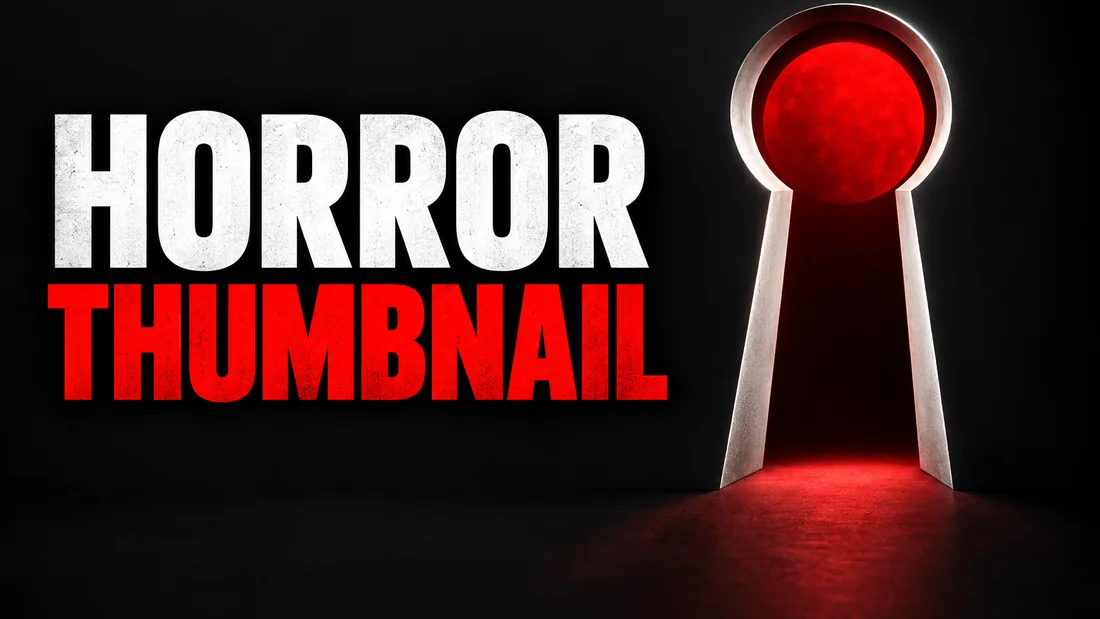
Horror thumbnail ideas for a scary story narration channel come down to one choice: show the place where the story happens, not the wound. A listener picking a Reddit horror story or a creepypasta at midnight is choosing a setting to sit inside for forty minutes; a rain-streaked window promises that better than a monster, and keeps the image inside the rules. As of September 2026, YouTube's Thumbnails policy page lists violent imagery that intends to shock or disgust, and graphic or disturbing imagery with blood or gore, among what is not allowed, and says a thumbnail that is not appropriate for all audiences may get the video age-restricted or the thumbnail removed.
This post covers six scenes, the words, the blood line, the mass-production signal, the palette, and one faceless brief per upload in WThumb.
Dread is a setting, not a wound
This section covers what a horror listener chooses between at midnight, and why the place beats the monster. The listener is not browsing for a scare but for a story to lie in the dark with, and scans for a situation they can already feel: a hallway with one light on, a break room at 3 AM, a road with no other cars. The picture's job is to say where you will be for the next forty minutes.
A monster on the thumbnail answers the story's question before the story starts. A place asks it. Two images for the same night-shift story: a creature with too many teeth behind a counter, or an empty counter, the fluorescent tube flickering, a name badge left face-down. The second reads as a story rather than a jump scare, which is what a narration channel sells.
Prompt packs underdeliver here: they give you monsters, which are easy to render. A scene has to be chosen, and choosing it is the work: one place, one time of night, one wrong detail. For a babysitting story that is a baby monitor on a kitchen counter, its light on, and the nursery door behind it closed when you left it open.
Six horror formats and the scene for each
This section names the scene for each of the six stories a narration channel runs on. Every scene has one wrong detail; the rest is an ordinary place at night. The rule is the reveal's, from the YouTube thumbnail ideas for every niche: hide the one thing the story is about and show everything else in full.
- The workplace story. The counter and the badge. A gas station at 3 AM with one pump lit and a customer's shadow that does not match the customer. Words: I WORKED THE NIGHT SHIFT.
- The house story. The hallway light. A door at the end of a corridor open two inches, warm light behind it, every other door shut. Words: DON'T OPEN THE DOOR.
- The road story. The headlights. A two-lane road in rain and one pair of high beams in the mirror, there for sixty miles. Words: IT FOLLOWED ME HOME.
- The childhood story. The toy. A stuffed rabbit on the bottom stair of a house where the children are grown. Words: MY IMAGINARY FRIEND WAS REAL.
- The sleep story. The bedroom window. Rain on the glass, a streetlight outside, curtains open a hand's width. Keep it quiet for the listener falling asleep to it. Words: SOMETHING TAPPED THE GLASS.
- The compilation. A number and one scene, not a collage. 5 TRUE STORIES over a single motel corridor beats five tiny scenes in a grid, because a grid reads as a menu.
Pick the scene from the story's first setting, not its scariest moment; the reveal is what the listener stays for. And nobody in it: the person in the story is the listener.
The words: the first line of the story, not a warning label
This section is about the text, and the rule is short: put the first line of the story on the image, not a genre label. A creepypasta thumbnail that says SCARY STORY tells a viewer on a horror channel nothing the channel name has not already said. The first line tells them which story.
Three words are almost always wasted on a horror channel: SCARY, TRUE and HORROR. Every upload is scary, most are called true in the title, and horror is the niche. Spend the space on the premise. I WORKED THE NIGHT SHIFT is a premise; TRUE SCARY STORY is a shelf label. The exception is a count: 5 TRUE STORIES earns its TRUE because the number is the promise.
Write the line as the narrator would say it: first person, capitals, two or three short lines. DON'T OPEN THE DOOR is an instruction the listener wants to see disobeyed. HE WAS ALREADY INSIDE is the sentence the story turns on, and it spoils nothing, because the story is about how.
A brief to paste
- Words. I WORKED THE NIGHT SHIFT on two lines.
- Instructions. An empty gas station counter at 3 AM, the fluorescent tube flickering, a name badge face-down, no person, no blood, no wounds, one light source.
Blood, gore and the fiction line
This section answers the question every horror creator asks: can you show blood in a YouTube thumbnail? The rule reads the image on its own, so fiction does not change the answer. As of September 2026, YouTube's Thumbnails policy page lists graphic or disturbing imagery with blood or gore, and violent imagery that intends to shock or disgust, among what is not allowed, and says it may make exceptions for educational, documentary, scientific or artistic context.
As of September 2026, YouTube's Violent or graphic content policies page says the policy also applies to thumbnails. It lists bodily fluids such as blood shown with the intent to shock or disgust, and dramatized or fictional footage of prohibited content where the viewer is not given enough context to understand that it is fictional. For educational content, the same page says, that context must appear in the images or audio of the video itself, not the title or description. A thumbnail is seen before any of that plays: a bloody hand on the image is a bloody hand.
Ads have their own tiers. YouTube's Advertiser-friendly content guidelines page, read in September 2026, says light or moderately shocking content that is obscured or shown in context can earn ad revenue, that highly shocking content where the whole purpose is to shock viewers earns none, and that thumbnails with graphic depictions of controversial issues, real or dramatized, receive limited ad earnings.
Age restriction is the quiet penalty. As of September 2026, YouTube's Age-restricted content page says that policy applies to custom thumbnails, that age-restricted videos are not viewable to users under 18 or signed out, and that they may have limited or no ads. A signed-out listener at 1 AM never sees the video; the thumbnail without gore reaches everyone. For stories about real people, see true crime thumbnail ideas without gore.
Faceless by design, not mass-produced
This section covers the other line a faceless channel can cross: not one thumbnail, but all of them. As of September 2026, YouTube's channel monetization policies page lists, under inauthentic content (the policy it renamed from repetitious content in July 2025), AI-generated content made with generic or unoriginal templates giving the impression of mass production, and a highly similar storyline template across multiple videos. The same page says reviewers cannot check every video and may focus on the channel's main theme, its most viewed and newest videos, and video metadata, including titles, thumbnails and descriptions. Twenty thumbnails of one corridor with a different word on each are twenty pieces of metadata saying the same thing.
Vary the place, not the palette. The channel look is the palette, the type and the one-light rule; the variety is the scene. A gas station this week, a bedroom window next, then a road, then a stairwell. Faceless channels work when the subject does a face's job, and here the subject is the place.
Prompt packs push the other way: sixty prompts in one style produce one recurring corridor, mass production in one folder. Whether you generate scenes in Midjourney for YouTube thumbnails or from a brief, the discipline is the same: one new scene per upload, chosen from the story.
The AI label is simpler. As of September 2026, YouTube's Disclosing use of GenAI content page lists using generative AI tools to create or improve a thumbnail under production assistance that does not require disclosure, gives a realistic scene that didn't actually occur as an example of what does, and says creators don't need to disclose non-realistic content made with AI. A generated hallway needs no label; the thumbnails policy still reads what is in it.
Palette and light: a dark ground, one light source, one warm accent
This section is the color rule for the whole channel: a dark ground, one light source, one warm accent. The ground is where the dread lives: navy, charcoal, green-black. The light source is what the eye finds first: a window, a lamp, headlights. The accent is the one warm thing in a cold picture: the amber of the window, the yellow of the words.
One light source does the most work. Two lights make a set; one makes a place. A bedroom with one streetlight through the curtains is a scene; the same bedroom lit evenly from nowhere is a render. One light also gives the words a home: the dark side of the frame is where the type reads.
The dark ground has one enemy: a white page, where a thumbnail that is black edge to edge is a hole with no edges, and the eye slides past. The light source fixes that: a window or headlights give the rectangle a bright shape that reads at any size. If a design comes back too dark at phone size, add light to the source, not to the ground. For the general lean, see YouTube thumbnail colors, dark or light.
A brief to paste
- Words. SOMETHING TAPPED THE GLASS on two lines.
- Instructions. A dark bedroom, a rain-streaked window, one streetlight outside as the only light, curtains open a hand's width, amber accent, no person, no blood, no wounds.
How to do this in WThumb
This section runs one upload through WThumb, with nobody in the picture. The reference is a brief, not a template: the idea carries over, the design is new.
- Paste the reference. A YouTube link to a horror narration thumbnail (WThumb fetches only that video's public thumbnail), or a PNG, JPEG or WebP upload.
- Type the words. Up to three lines: I WORKED THE NIGHT SHIFT on two, the first line of the story.
- Write one line of instructions. An empty gas station at 3 AM, one pump lit, a name badge face-down, no person, no blood, no wounds, one light source. Your words pass a moderation check first; a refused request is never generated and costs nothing.
- Leave the personal photo out. The person in the reference is removed and the space is filled in the same style. Nobody else's face is ever put in.
- Tick 16:9 and 9:16. Both in one submission, so the same scene reaches the Shorts feed. One or two designs.
- Wait about thirty seconds. The result is a Full HD+ JPEG.
Your last thumbnail as the next reference
Once the channel has a look, stop borrowing. Upload your own last image as the reference, keep the words and light rules, and change only the place: the gas station becomes a laundromat, the rain becomes fog. There is no policy awareness in WThumb; the no blood, no wounds line is yours to write every time.
Revise it if it came back evenly lit
If the scene came back evenly lit, press the pencil on it and describe one change in plain words: make the streetlight the only light and darken the rest. Each revision costs one credit (1 credit = 1 thumbnail), and it works later too, from the reopened conversation. The first two runs on a new account cost nothing, because the account starts with two free credits, no card needed.
The scariest thing on a horror thumbnail is the place where it happens. Leave the blood out; the policy reads the image, not your story.