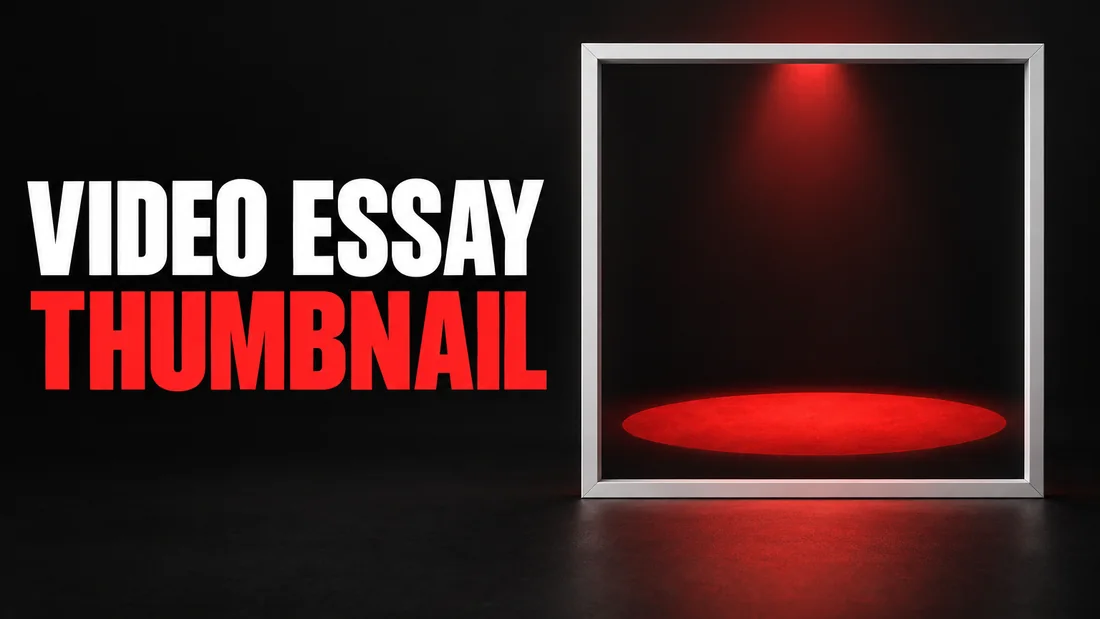
A video essay thumbnail has a harder job than a vlog's: the subject is someone else's film, game or moment, and the obvious image, a still from it, is not yours to use. The fix is a split: the title names the subject, and the thumbnail names the argument, in three words over one object you can show. As of September 2026, YouTube's Copyright on YouTube page lists posters, movies and online videos among the works eligible for copyright protection, and says intangible things like ideas, facts, and processes aren't subject to copyright. The still and the poster are theirs. The thesis is yours.
This post covers what the words should claim, why a credited still is still a still, what to show instead, whether the narrator and the AI label belong, and how to brief it in WThumb.
The thesis in three words
This section covers what the words on an essay thumbnail should do: make a claim, not name a title. A review thumbnail asks WORTH IT? An essay thumbnail answers a question the viewer did not know they had. WHY IT FAILED over a single object promises an explanation. THE LAST GOOD ONE promises a ranking with a cut-off. NOBODY WATCHED IT promises the story of a flop. Each is a claim, and a claim is what an essay is.
The split matters because the title already does the naming. In the feed it sits under the image and names the film, the game, the moment. If the thumbnail repeats it, the viewer reads the subject twice and the argument never. The title reads Why the third film lost its audience; the thumbnail reads WHY IT FAILED over one empty red theater seat. Neither needs a frame from the film.
For a commentary channel the subject is a person or a moment, and the same split holds: the title names the event, the thumbnail names your reading of it, with the subject shown as a thing rather than a face. A microphone on an empty stage under IT WAS SCRIPTED. Three words is the working limit; a candidate that needs a fourth is a title, not a thesis.
A brief to paste
- Words. WHY IT FAILED on two lines.
- Instructions. One empty red theater seat in a dark auditorium, a thin beam of projector light from behind, no person, no logos.
The single still, and why credit does not make it fair use
This section explains why the frame you most want is the one to leave out. A still is a frame of an audiovisual work and a poster is a visual work; YouTube's Copyright on YouTube page, read in September 2026, names movies and online videos in the first group and posters and advertisements in the second.
As of September 2026, YouTube's Fair use on YouTube page lists the four factors: the purpose and character of the use, the nature of the copyrighted work, the amount and substantiality of the portion used, and the effect of the use upon the potential market. The page does not mention thumbnails. Forty minutes of commentary may transform the film; a thumbnail is one unaltered frame in a feed with no commentary around it. Nobody can promise that a court would call that fair, and this post will not.
Two habits do not help. The same page says giving credit to the owner of a copyrighted work won't by itself turn a non-transformative copy into fair use, and that including the phrase no infringement intended won't automatically protect you from a claim of copyright infringement. It adds that if what's borrowed is considered the heart of the work, sometimes even a small sampling may not be fair use. One frame is a small sampling. The famous shot, the twist, the poster image: usually the heart.
Two posts carry the licensing detail: a picture from Google Images as a YouTube thumbnail and history documentary thumbnail ideas, which covers archival images and the public domain. The practical answer for an essay is unchanged: the still is theirs, so show something else. BookTube meets the same question with the publisher's cover; the BookTube thumbnail ideas take it on directly.
The object stand-in
This section is the replacement for the still: one object that stands for the subject, described in plain words. Name the era, the object and the mood, not the film. An essay on a nineties horror sequel does not need the monster; it needs a VHS tape on a brown carpet lit by television glow. The viewer who knows the film reads the object; the viewer who does not reads the mood, and the title fills in the name.
Describe the object as a class, not a brand. A gray handheld console from the nineties is a brief; a named console is a request for someone's product design. The same goes for a franchise mask, car or costume: describe the shape, the color and the wear, and let the design be new. The general case is covered in faceless thumbnails without a person; the essay case is narrower: the object must point at one work without copying anything from it.
Three kinds of object work. The medium: a tape, a disc, a cartridge, a paperback, a ticket stub. The place: a seat, a cabinet, a couch facing a screen that is only glow. The aftermath: a pale rectangle on a wall where a poster hung, a shelf with one gap. Pick one; two objects and the words start to compete.
A brief to paste
- Words. THE LAST GOOD ONE on two lines.
- Instructions. A worn gray game cartridge upright on a wooden shelf, warm lamp light from the left, deep shadow behind it, no person, no logos, no text on the cartridge.
The narrator, optional
This section decides whether you belong in the frame, and the answer depends on what the channel sells. If it sells your take, an opinion essay with a recurring host, your face is the through-line: viewers subscribe to the person who argues, and a thumbnail that shows the arguer is a promise the video keeps. If it sells the analysis, a film breakdown, a games history, a faceless brand with a narrator's voice, a face dilutes it: one more thing to read before the object and the words.
Cover the words and ask what the image promises. A face mid-reaction promises a reaction. A seated figure looking at the object promises consideration. If you go in, go in seated and side-lit, looking at the object rather than the camera: one lamp from the left, the cartridge or the tape in front of you. It reads as thought, not shock.
In WThumb this is one decision. Add a personal photo and you are placed in the design; skip it and the result is faceless, with the person in the reference removed and the space filled in the same style. Nobody else's face is ever put in: the director, the actor and the other YouTuber stay out.
A brief to paste
- Words. I WAS WRONG on two lines.
- Instructions. Me seated at a dark desk, lit from the left, looking down at a small gray console in front of me, the rest of the room in shadow.
Words that name the subject without the studio's art
This section covers the words: what they should say, and the line they must not cross. The title says the film; the thumbnail says the argument. That also keeps the film's logo lettering off the image: the studio's typeface is the studio's art, and it repeats what already sits under the image. If the name must be on the picture, plain heavy type does it.
The line is the misleading one. As of September 2026, YouTube's Thumbnails policy page lists, among what is not allowed, a thumbnail that misleads viewers to think they're about to view something that's not in the video, and says that if a thumbnail violates other policies YouTube removes it and may issue a strike, while a first violation will likely get a warning with no penalty. THE ENDING IS A LIE over a video about pacing is a claim the video never makes. THEY CUT IT over an essay about a deleted scene is one it spends forty minutes on. Write the thesis you actually defend.
The same month, YouTube's Thumbnail & title tips page says to try not to make the design too complex, that dynamic use of color and composition can help catch the eye but too much can overwhelm it, to use a font that's easy to read if you add text, and to be accurate, so the title represents the video. For an essay: one object, three words, a heavy plain font, and a thesis the title can stand behind.
Does an AI-made essay thumbnail need the AI label?
This section answers the disclosure question, which comes up because the image is rendered, not photographed. As of September 2026, YouTube's Disclosing use of GenAI content page lists, among examples that do not require disclosure, production assistance, like using generative AI tools to create or improve a video outline, script, thumbnail, title, or infographic. A rendered VHS tape under WHY IT FAILED is production assistance. No label.
The same page says disclosure is required when content makes a real person appear to say or do something they didn't do, or generates a realistic scene that didn't actually occur. The boundary is one of subject, not of tool. A realistic image of a real director on set doing something he never did is a fake scene. Another YouTuber crying at a desk, rendered realistically, is a fake scene of a real person. Neither belongs on an essay thumbnail; the label would only make it labeled.
In WThumb the boundary comes from what the tool will not do, not from any policy awareness. Nobody else's face is ever put in: the person in the reference is removed, or you are placed in the design, and a likeness of the subject never is. Your words are checked by a moderation service before anything is generated; a refused request costs nothing. Brief the object and the mood, not the person, and the question answers itself.
How to do this in WThumb
This section is the flow for one essay thumbnail, faceless by default. The reference is a brief, not a template: the idea carries over, the design is new. Copying a YouTube thumbnail style has the detail; one object under a two-word verdict is nobody's property.
- Paste the reference. A YouTube link (WThumb fetches only that video's public thumbnail) or a PNG, JPEG or WebP upload; an essay channel's thumbnail is the natural pick.
- Type the thesis as the words. Up to three lines: WHY IT FAILED, or THE LAST GOOD ONE. The film's name belongs in the title.
- Describe the object in one instruction line. A dusty VHS tape on a brown carpet, television glow from the right, no person, no logos: era, object and mood, not the film.
- Choose faceless or narrator. Skip the personal photo and the person in the reference is removed, the space filled in the same style; add yours and you sit in the design.
- Tick the formats. 16:9, plus 9:16 if there is a Shorts cut, both in one submission, one design or two.
- Wait about thirty seconds. A Full HD+ JPEG. As of September 2026, YouTube's Add custom thumbnails page names 3840 by 2160 pixels for videos and a minimum width of 640 pixels; the file sits between them, and YouTube re-encodes every upload anyway.
- Revise it if needed. The pencil on a finished thumbnail takes one change in plain words and makes a new version; one credit per revision (1 credit = 1 thumbnail).
A disc or book you own as @1
A copy you own is a real object. Attach a photo of the disc, cartridge or paperback as an extra image and point at it: @1 on a wooden shelf, warm light from the left. It is a brief too, so shelf and light are designed around it. Shoot the spine or a plain edge; the front is still the studio's art. And new accounts get two free credits, no card needed.
The title names the film. The thumbnail names the argument.